Industrial Fan VFD Selection: Key Checks and RFQ Checklist
Share
Preparing an industrial fan VFD enquiry? Start with the motor, supply, fan duty and control requirements. Then ask for a documented model proposal against that application brief. This guide helps OEM engineers, control cabinet builders and industrial buyers prepare the information for that review.
Why motor power alone is not enough
A matching kW or hp label does not complete a drive selection. ABB's dimensioning procedure also checks supply conditions, load characteristics and drive current capability; application current must be considered against drive current limits (ABB, 2022, pp. 6–7, 23).
Ask the quotation to identify the proposed drive's continuous output-current rating, short-term overload conditions and applicable duty rating. Provide the motor nameplate and ask how the proposal meets the actual application. Do not turn a power label or one current reading into a universal sizing rule.
Check the application before comparing drives
Motor, power supply and actual load
Send a clear nameplate photo and copy the marked motor type, power, voltage, current, frequency and speed. State the available supply voltage, phase and frequency separately. For a replacement, include the existing drive's full model code and describe why it is being replaced.
Describe the fan's normal duty, operating hours, starts and unusual load conditions. Attach existing current records if available, with the speed and operating condition at each reading. ABB's selection process considers load type, speed range, continuous current and maximum current (ABB, 2022, pp. 6–7). Ask the supplier to explain any required rating adjustment for the proposed duty.
Fan duty and permitted speed range
State the fan type, required airflow and pressure, with units, and attach the manufacturer's fan curve. DOE identifies these system requirements as part of fan selection (U.S. Department of Energy, 2003, pp. 4, 6).
Lower speed is not suitable for every operating point: DOE discusses instability, resonance and pressure limitations when using VFDs with fans (U.S. Department of Energy, 2003, pp. 45–46). Ask the fan manufacturer and responsible engineer to confirm the permitted range and any excluded speeds. Record the minimum process requirement rather than assuming that the fan can run continuously at any requested frequency.
For a self-ventilated induction motor, reduced speed can also reduce thermal loadability (ABB, 2022, p. 22). Request a review of the actual motor's cooling and continuous duty at the intended low-speed operating point. This is not a generic minimum-speed setting.
Speed control and communication
Identify where the speed command will come from: local panel, analogue signal, PLC or another controller. State any required control mode, process-feedback variable, sensor and responsibility for designing the control arrangement. Ask the proposal to identify the exact functions and options used.
Specify the electrical interface and communication protocol separately. RS-485 defines electrical characteristics; it does not by itself identify the application protocol (Kugelstadt, 2021, p. 1). Include the controller documentation and the commands, status and fault information required. Ask for the protocol and register documentation for the quoted hardware and firmware, including any gateway or optional board.
Installation environment
Drive-system dimensioning includes environmental conditions (ABB, 2022, unnumbered introductory page). Describe the installation location, ambient conditions, enclosure or cabinet arrangement, dust, moisture and altitude where relevant. Request the proposed model's documented limits and any applicable derating; do not apply another model's limits to the quotation.
Compare Harristian models against the same brief
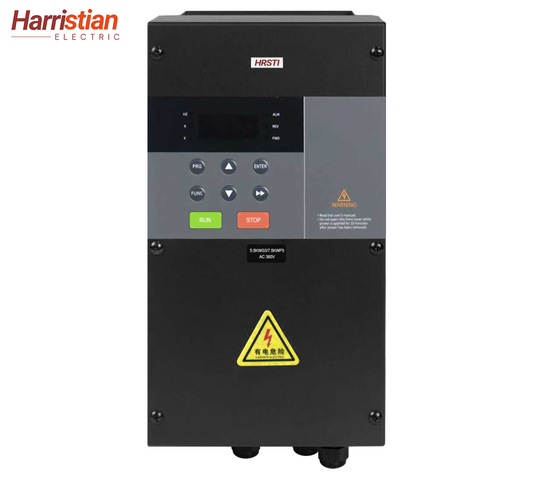
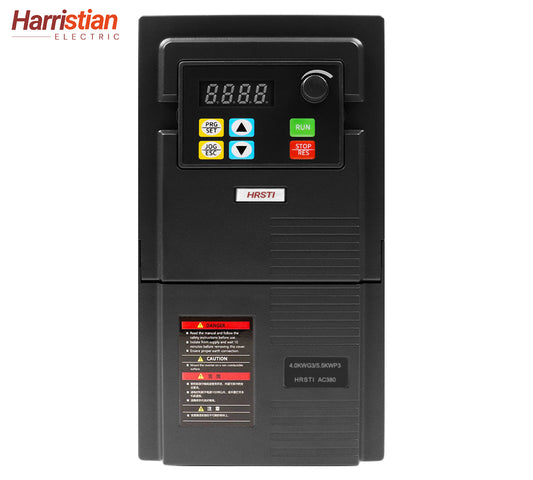
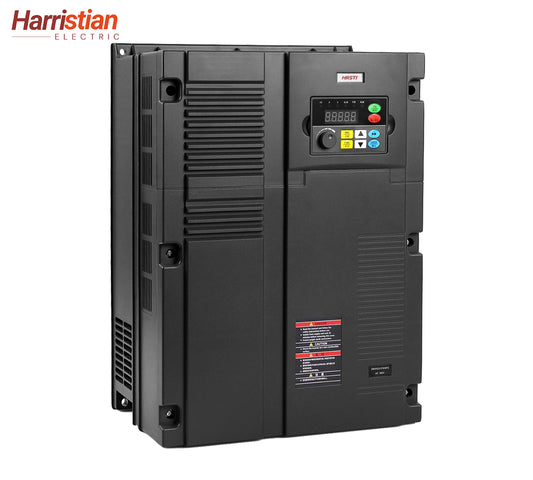
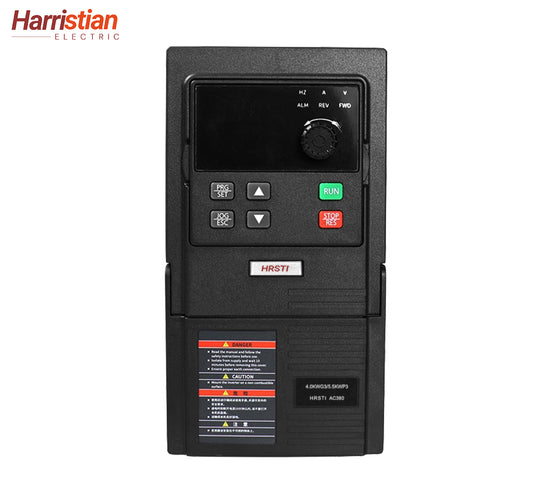
Use the Harristian VFD range as an enquiry starting point. If your shortlist names HS320, HS321, HS720 or HS720H, request a comparison for the exact model, hardware, firmware and manual revision under consideration.
Ask each proposal to identify:
- The motor and duty assessment, quoted output-current rating and rating conditions.
- The documented control functions, command inputs and communication interface/protocol.
- Required options, installation limits and any exceptions to your application brief.
Confirm availability and configuration with the quotation. Do not assume that HS320 and HS321 have identical interfaces, that HS720 documentation establishes HS720H functions, or that a higher series number proves a better fit. Compare documented configurations rather than a family name alone.
Send a complete fan VFD RFQ
Copy this checklist into your enquiry. Mark unknown items for review rather than filling them with assumptions.
| RFQ item | Information to provide |
|---|---|
| Motor nameplate | Clear photo; marked motor type, power, voltage, current, frequency and speed |
| Power supply | Available voltage, phase and frequency |
| Fan type and operating requirements | Fan/application description; airflow and pressure with units; fan curve; operating hours, starts and proposed speed range |
| Speed control and communication requirements | Command source; required control mode or feedback; electrical interface and protocol; controller documentation |
| Installation environment | Location, ambient conditions, cabinet/enclosure arrangement and relevant dust, moisture or altitude conditions |
| Project quantity | Sample and production quantities, expected repeat demand and requested delivery timing |
| Destination country or market | Delivery destination and any project documentation or compliance requirements to be reviewed |
Send Harristian your fan VFD RFQ and request a documented model proposal, including its manual revision, options and outstanding technical questions. Keep the agreed configuration with the sample and repeat-order records.
Final sizing, electrical design, protection and commissioning require application-specific review by qualified personnel. This checklist provides no installation approval, universal selection formula or fixed energy-saving commitment.
References
ABB (2022) Dimensioning of a drive system. Technical guide No. 7, 3AFE64362569, revision D, 18 January 2022. ABB. Available at: https://library.e.abb.com/public/e555e5106a3c44e882f48b75a44f6807/Technical_guide_No_7_3AFE64362569_RevD_EN_lowres.pdf (Accessed: 28 October 2026).
Kugelstadt, T. (2021) The RS-485 design guide. Application report SLLA272D, revision D, revised May 2021. Texas Instruments. Available at: https://www.ti.com/lit/an/slla272d/slla272d.pdf (Accessed: 28 October 2026).
U.S. Department of Energy (2003) Improving fan system performance: A sourcebook for industry. DOE/GO-102003-1294. Developed jointly with the Air Movement and Control Association International, Inc.; prepared by Lawrence Berkeley National Laboratory and Resource Dynamics Corporation. U.S. Department of Energy, Office of Energy Efficiency and Renewable Energy, Industrial Technologies Program. Available at: https://www.energy.gov/sites/prod/files/2014/05/f16/fan_sourcebook.pdf (Accessed: 28 October 2026).